Source context
An international remote-staffing agency (B2B) that provides virtual assistants and remote talent to businesses. Revenue: sourcing fees, monthly management fees and staffing contracts.
← All case studies · B2B · Remote staffing agency · Global
An international agency that places virtual assistants and remote talent with businesses. Before any content was written, I built the semantic blueprint: the five components, the research, and a map of every page the site needs, in priority order.
01The business
Outsourcing is dominated by big agencies and listicles that all say the same thing. To be seen as an authority, the site needed to cover the whole topic, from "what is outsourcing" to choosing a partner, in a structure Google can understand, and to connect every informational page back to the hiring service.
02The 5 components
Before collecting a single topic, the five components fix what the site is about, who it serves and how informational pages lead to the service.
An international remote-staffing agency (B2B) that provides virtual assistants and remote talent to businesses. Revenue: sourcing fees, monthly management fees and staffing contracts.
Outsourcing, anchored to its Wikipedia entity so the whole map shares one meaning.
Know, find, screen and hire remote talent.
Every attribute of outsourcing that leads to the service: hiring remote talent, costs, models, countries, roles.
Everything else people want to know about outsourcing and virtual assistants: definitions, history, comparisons, risks.
03Research
Phase 1 · Steps 1–5
Source context, central entity, central search intent, core section and outer section, agreed before any topic research.
Phase 2 · Steps 6–19
Buyer personas, Wikipedia and expert sources, LLM entity research, knowledge domains, lexical relations, ontology, frame semantics, query networks, SERP analysis (autocomplete, PAA, knowledge panels, competitor query networks), forums and competitor sitemaps. Then SERP-based clustering to decide which queries deserve their own page.
Phase 3 · Steps 20–26
Title tag, URL, image name, alt text and meta description for every page, quality nodes highlighted, and a publishing momentum plan.
04The topical map
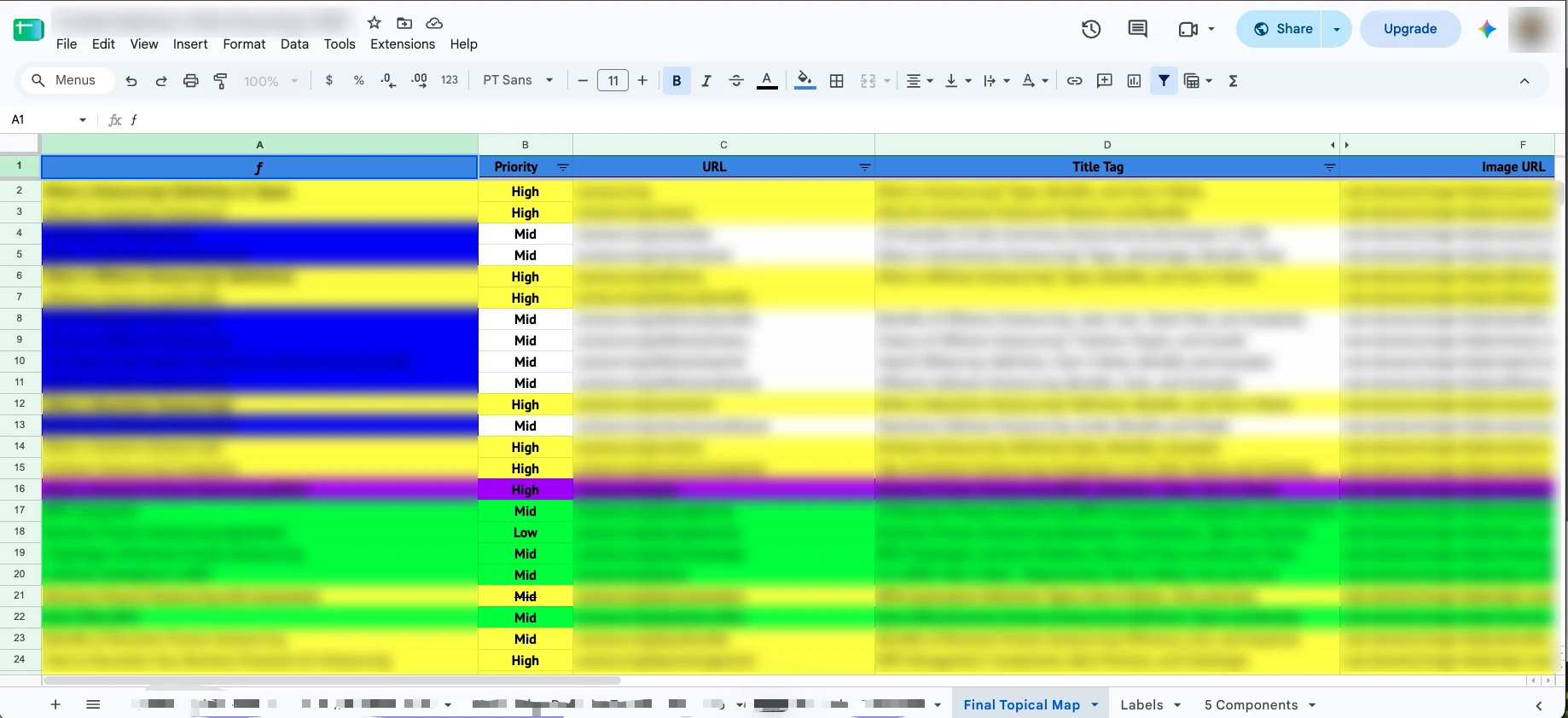
The final map gives each page a priority, a URL in a clear parent-child hierarchy, a title tag, an image name and alt text. Colours mark the status of each page, from brief ready to published. Topic names are hidden to protect the client.
05What came next
I build the topical map first, so every article you publish has a reason to exist and a place to link.